The course

Eighteen holes laid out in 1897 across the park of a Georgian house. Firm, walked, and played in a little over three hours.

The course from the hill above the eleventh: striped fairways between oaks and cedars, the mere, and the House in the middle distance

The course

Eighteen holes laid out in 1897 across the park of a Georgian house. Firm, walked, and played in a little over three hours.

The course from the hill above the eleventh: striped fairways between oaks and cedars, the mere, and the House in the middle distance

The course

Eighteen holes laid out in 1897 across the park of a Georgian house. Firm, walked, and played in a little over three hours.

The course from the hill above the eleventh: striped fairways between oaks and cedars, the mere, and the House in the middle distance

Hole by hole

Hole by hole

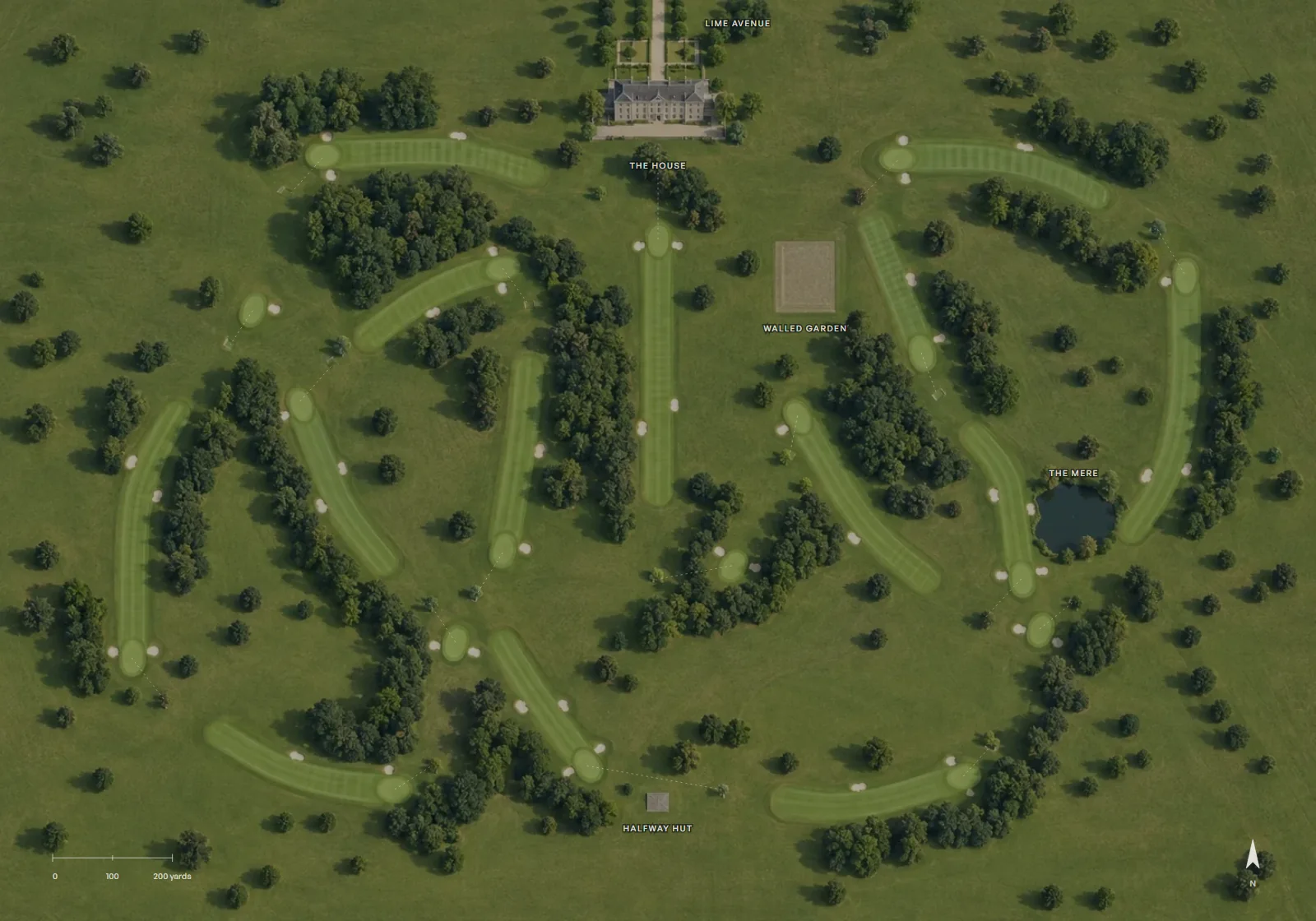
Two loops of nine through the old park, west and east of the lime avenue, with the Head Professional’s note on every hole.

6,931 yards · 

Par 71 · 

Out 3,373 · 

In 3,558

Aerial plan of the Averleigh estate and its eighteen holes

01

Blue

White

Red

The Cedars

Par

4

Yards

473

Index

5

Off the terrace and away from the House. The ground falls left toward the cedars, so hold your drive into the upslope on the right.

Edward Lang, Head Professional

01

Par 4

02

Par 3

03

Par 5

04

Par 4

05

Par 3

06

Par 4

07

Par 4

08

Par 4

09

Par 4

10

Par 4

11

Par 3

12

Par 5

13

Par 4

14

Par 4

15

Par 4

16

Par 4

17

Par 3

18

Par 5

01

Par 4

02

Par 3

03

Par 5

04

Par 4

05

Par 3

06

Par 4

07

Par 4

08

Par 4

09

Par 4

10

Par 4

11

Par 3

12

Par 5

13

Par 4

14

Par 4

15

Par 4

16

Par 4

17

Par 3

18

Par 5

The scorecard

The scorecard

Yardages are measured from the medal plates.

Tees

Yards

Rating

Slope

Blue

Men

6,931

73.4

138

White

Men

6,619

72.1

134

Red

Ladies

5,752

74.0

131

Tees

Yards

Rating

Slope

Blue

Men

6,931

73.4

138

White

Men

6,619

72.1

134

Red

Ladies

5,752

74.0

131

Hole

Blue

White

Red

Par

Stroke index

1

473

452

393

4

5

2

203

194

168

3

15

3

567

541

471

5

9

4

420

401

349

4

3

5

211

202

175

3

17

6

408

390

339

4

7

7

333

318

276

4

13

8

417

398

346

4

1

9

341

326

283

4

11

Out

3,373

3,222

2,800

35

Hole

Blue

White

Red

Par

Stroke index

10

412

393

342

4

4

11

215

205

178

3

16

12

602

575

500

5

10

13

454

434

377

4

2

14

279

266

232

4

18

15

351

335

291

4

12

16

468

447

388

4

6

17

209

200

173

3

14

18

568

542

471

5

8

In

3,558

3,397

2,952

36

Total

6,931

6,619

5,752

71

The course today

The course today

Open, all eighteen holes

Greens

10.5 ft

Cut and rolled, measured on the Stimpmeter at 6.30

Tees

Blue and white in play

Buggies

Medical only

Practice ground

Open

The twelfth and the seventeenth

The twelfth and the seventeenth

Ask Edward Lang which holes visitors remember and he will name these two. His notes on playing them.

Ask Edward Lang which holes visitors remember and he will name these two. His notes on playing them.

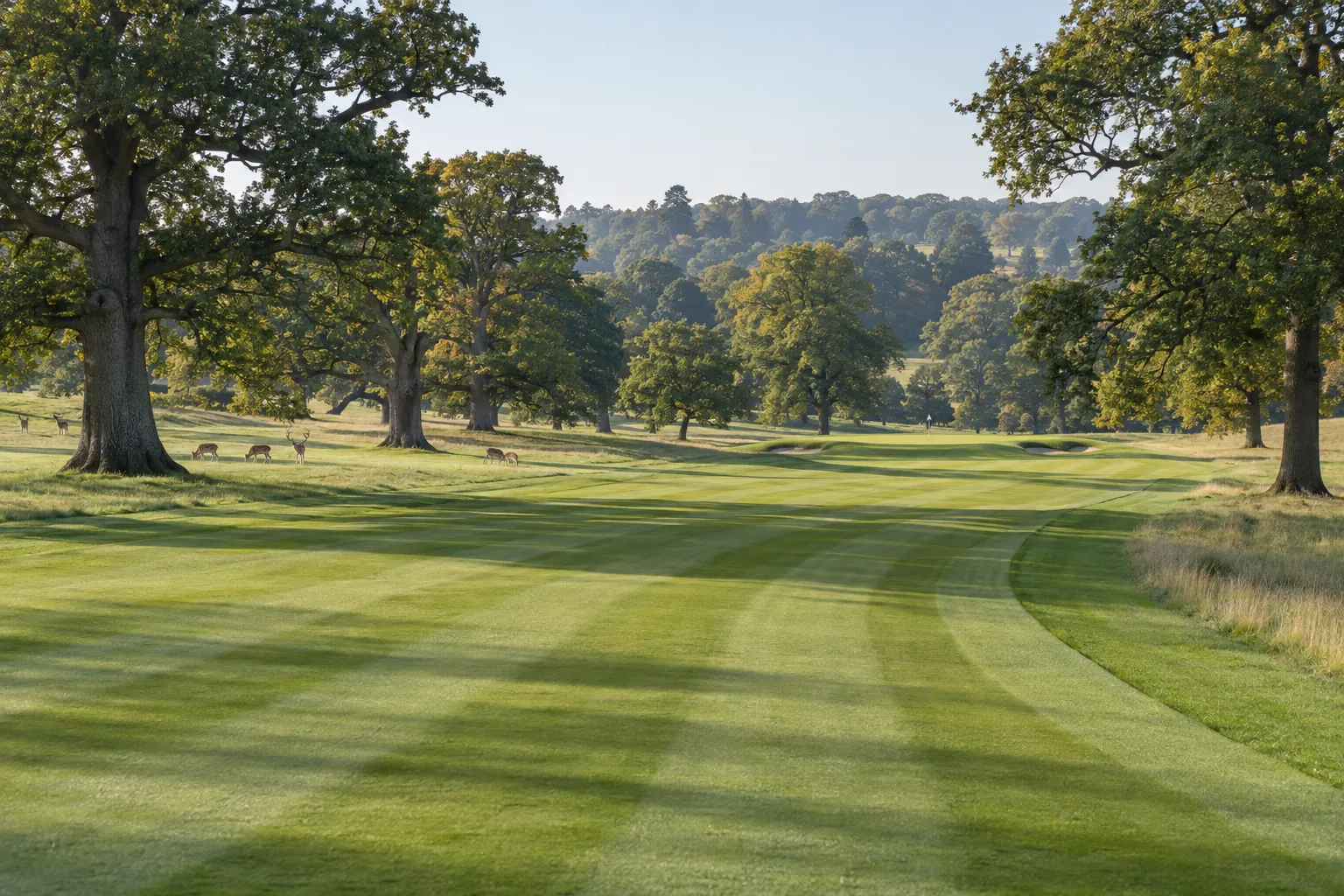
The twelfth fairway running away through the old deer park, broad oaks on either side and a small herd of fallow deer grazing beneath them

The twelfth from the right of the fairway, the herd under the park oaks

12

Deer Park

Par 5 · 602 yards from the blue · Index 10

The longest hole on the card, and the one visitors are still talking about at lunch.

The fairway runs through what was the deer park, and the herd is usually somewhere off to the left. They were here first and they have right of way.

From the tee, favour the right half. The two big oaks on the left catch more drives than they deserve, and from behind them there is no way forward.

The second shot is the decision. Stay right of the last oak and you have a short iron to a long green that tilts gently toward you. Go left of it and you are pitching over the tree line.

From the tee

Right half of the fairway, away from the oaks

The second

Right of the last oak, about 140 yards out

On the green

Long and gentle; most putts break toward the park

Edward Lang, Head Professional · See the 12th on the plan

17

Folly

Par 3 · 209 yards from the blue · Index 14

A long short hole to a green with two tiers and most of the day’s arguments.

The temple was built for the House in the 1780s, and the green was cut beneath it in 1897. You play across the hollow, and the hollow is further than it looks from the tee.

When the flag is on the top tier, take one more club than the yardage. The bank between the tiers sends anything short back down to the front, and from there two putts is a good effort.

Both bunkers are deep, the left one more so. When the wind comes off the folly, nothing stays on the top tier and the members will tell you so.

From the tee

One more club when the flag is on the top tier

Short

Short and right is the place to miss

On the green

Read the bank between the tiers before anything else

Edward Lang, Head Professional · See the 17th on the plan

The seventeenth green across a grassy hollow, two bunkers cut into its banks and the domed stone temple folly on the rise behind

The seventeenth, across the hollow to the green beneath the temple

Kept at first light

Kept at first light

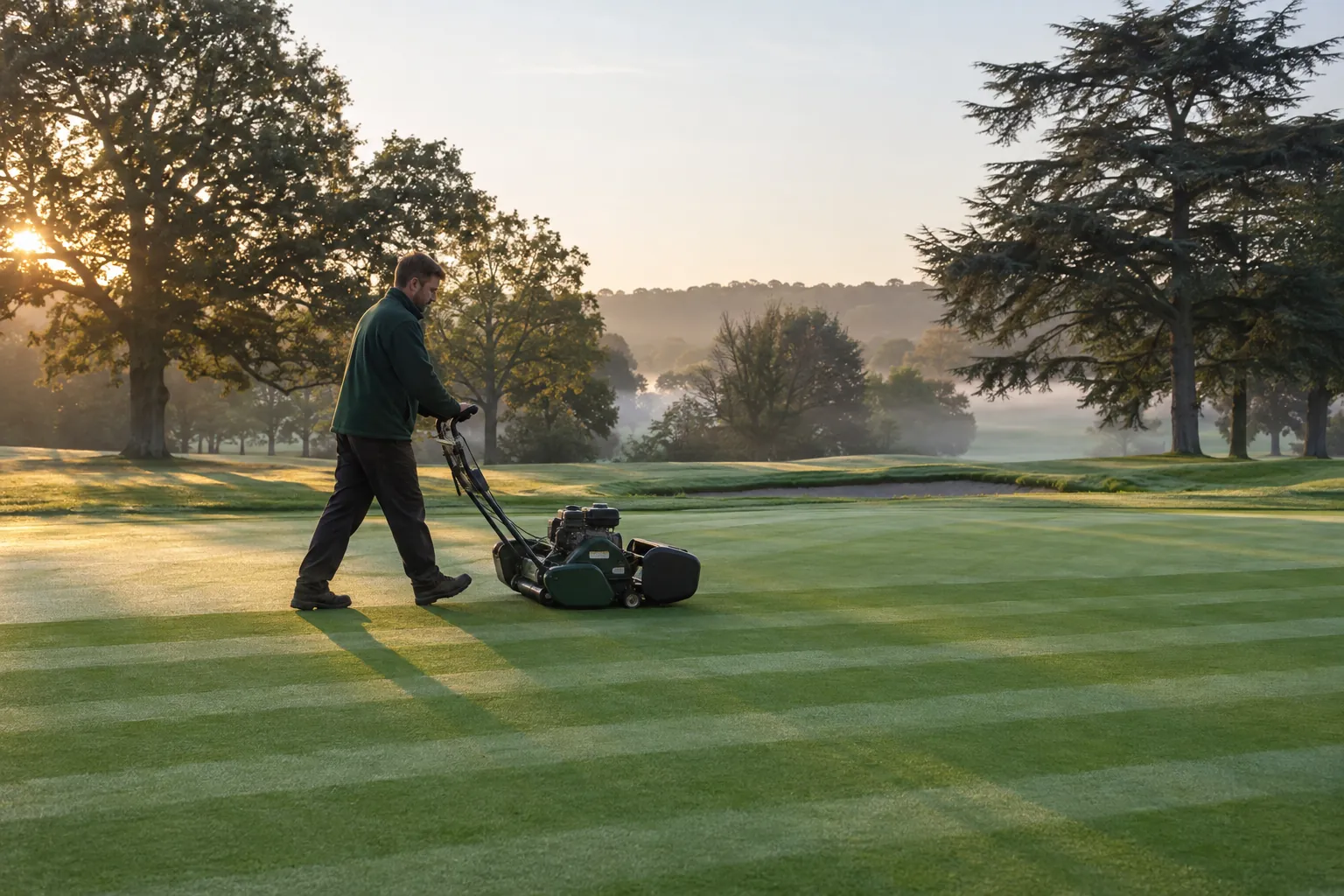
Owen Pryce has been Course Manager since 2014. He and a greenkeeping team of nine are out before the first members, and the greens are cut by hand before anyone tees off.

Owen Pryce has been Course Manager since 2014. He and a greenkeeping team of nine are out before the first members, and the greens are cut by hand before anyone tees off.

A greenkeeper walking a hand-pushed mower across a striped green at dawn, mist in the park and the sun low behind the oaks

The 9th green at 6.10 on a September morning

Owen Pryce

Course Manager

Head Greenkeeper

The greens, and the morning course report

Deputy Head Greenkeeper

Irrigation, the mere and the bunkers

Five greenkeepers

Tees, fairways and the park

Mechanic

The hand mowers, ground every week

Apprentice

Two years between the club and college

Every member of the team plays. They are on the course at the times it matters, and they will step aside for you when you are ready to play.

The year on the course

The year on the course

The work that keeps the greens firm and true, and when it happens. Dates move with the weather; the course report always has the latest.

The work that keeps the greens firm and true, and when it happens. Dates move with the weather; the course report always has the latest.

Jan

Feb

Mar

Apr

May

Jun

Jul

Aug

Sep

Oct

Nov

Dec

Scarifying

March

The greens are scarified to thin the thatch before the season starts, then top-dressed with sand and brushed in.

J

F

M

A

M

J

J

A

S

O

N

D

Verti-draining

April

Solid tines go deep into the Wealden clay to let air and water through. The greens roll true again within a few days.

J

F

M

A

M

J

J

A

S

O

N

D

Greens cut every morning

May to September

Cut with hand-pushed mowers before the first tee time and rolled on alternate days. The Stimpmeter reading goes on the course report.

J

F

M

A

M

J

J

A

S

O

N

D

Hollow-tining

Late August

The one week the greens are not at their best. Cores come out, sand goes in, and the greens are back in play within ten days.

J

F

M

A

M

J

J

A

S

O

N

D

Overseeding

September and October

Fine fescue and bent are sown into the greens and the worn tees while the soil is still warm.

J

F

M

A

M

J

J

A

S

O

N

D

Tree work

November to February

The oaks, limes and cedars of the park are surveyed each autumn and the work is done while the course is quiet.

J

F

M

A

M

J

J

A

S

O

N

D

Temporary greens

Rarely, in hard frost

Only when frost or standing water would damage the greens, and seldom for more than a morning.

J

F

M

A

M

J

J

A

S

O

N

D

Jan

Feb

Mar

Apr

May

Jun

Jul

Aug

Sep

Oct

Nov

Dec

Scarifying

March

The greens are scarified to thin the thatch before the season starts, then top-dressed with sand and brushed in.

J

F

M

A

M

J

J

A

S

O

N

D

Verti-draining

April

Solid tines go deep into the Wealden clay to let air and water through. The greens roll true again within a few days.

J

F

M

A

M

J

J

A

S

O

N

D

Greens cut every morning

May to September

Cut with hand-pushed mowers before the first tee time and rolled on alternate days. The Stimpmeter reading goes on the course report.

J

F

M

A

M

J

J

A

S

O

N

D

Hollow-tining

Late August

The one week the greens are not at their best. Cores come out, sand goes in, and the greens are back in play within ten days.

J

F

M

A

M

J

J

A

S

O

N

D

Overseeding

September and October

Fine fescue and bent are sown into the greens and the worn tees while the soil is still warm.

J

F

M

A

M

J

J

A

S

O

N

D

Tree work

November to February

The oaks, limes and cedars of the park are surveyed each autumn and the work is done while the course is quiet.

J

F

M

A

M

J

J

A

S

O

N

D

Temporary greens

Rarely, in hard frost

Only when frost or standing water would damage the greens, and seldom for more than a morning.

J

F

M

A

M

J

J

A

S

O

N

D

Local rules

Local rules

These are the ones that come up. The full local rules are printed on the back of the scorecard and posted in the changing rooms, and the Secretary’s office will help with anything they do not cover.

Out of bounds

The estate wall

Beyond the estate wall wherever it runs beside the course. The boundary edge is the course-side face of the wall at ground level.

The House garden, the stable yard and the car park are also out of bounds, marked by white stakes.

Out of bounds

The estate wall

Beyond the estate wall wherever it runs beside the course. The boundary edge is the course-side face of the wall at ground level.

The House garden, the stable yard and the car park are also out of bounds, marked by white stakes.

The ha-ha on the 2nd

Hole 2

The sunken wall in front of the 2nd green is an integral part of the course. There is no free relief from it.

Play the ball as it lies, or take unplayable ball relief under Rule 19 with one penalty stroke.

The ha-ha on the 2nd

Hole 2

The sunken wall in front of the 2nd green is an integral part of the course. There is no free relief from it.

Play the ball as it lies, or take unplayable ball relief under Rule 19 with one penalty stroke.

The mere on the 15th

Hole 15

The mere is a red penalty area. As well as the options under Rule 17, you may drop in the dropping zone short and right of the green, with one penalty stroke.

The mere on the 15th

Hole 15

The mere is a red penalty area. As well as the options under Rule 17, you may drop in the dropping zone short and right of the green, with one penalty stroke.

Young trees

Throughout

Staked trees are no play zones. If your ball lies on or touches one, or a staked tree interferes with your stance or the area of your intended swing, you must take free relief under Rule 16.1f.

Young trees

Throughout

Staked trees are no play zones. If your ball lies on or touches one, or a staked tree interferes with your stance or the area of your intended swing, you must take free relief under Rule 16.1f.

Preferred lies

November to March

From 1 November to 31 March, when your ball lies in a part of the general area cut to fairway height or less, you may lift, clean and place it once, within one scorecard length of the original spot and not nearer the hole.

Preferred lies

November to March

From 1 November to 31 March, when your ball lies in a part of the general area cut to fairway height or less, you may lift, clean and place it once, within one scorecard length of the original spot and not nearer the hole.

Distance-measuring devices

Permitted

You may use a device that measures distance. In a competition, any function that gauges slope, wind or club choice must be switched off.

Distance-measuring devices

Permitted

You may use a device that measures distance. In a competition, any function that gauges slope, wind or club choice must be switched off.

Visitors play on Tuesday, Wednesday and Thursday, by arrangement with the Secretary’s office.

Create a free website with Framer, the website builder loved by startups, designers and agencies.